Published on 11th May 2026
Leadership Development for Line Managers: Why HR Should Flip the Org Chart
12 minute read
A huge amount of time and effort goes into creating organisational charts, often with a surprising focus on making them look neat, polished and visually appealing. But what if presenting them in a different way could be your secret weapon for leadership development among line managers?
Contents
The Message Your Org Charts Really Send
The Problem with the Traditional Org Chart
Servant Leadership Is Not About Being Soft
A Visual Cue That Changes the Conversation
What an ‘Upside-Down’ Org Chart Communicates
Three Questions Every Line Manager Should Be Able to Answer
A Simple Exercise for Your Next Leadership Session
The Message Your Org Charts Really Send
If you’re looking at leadership development for line managers in your organisation, I’ve got a simple idea for you.
It costs nothing beyond a little time, thought, and effort.
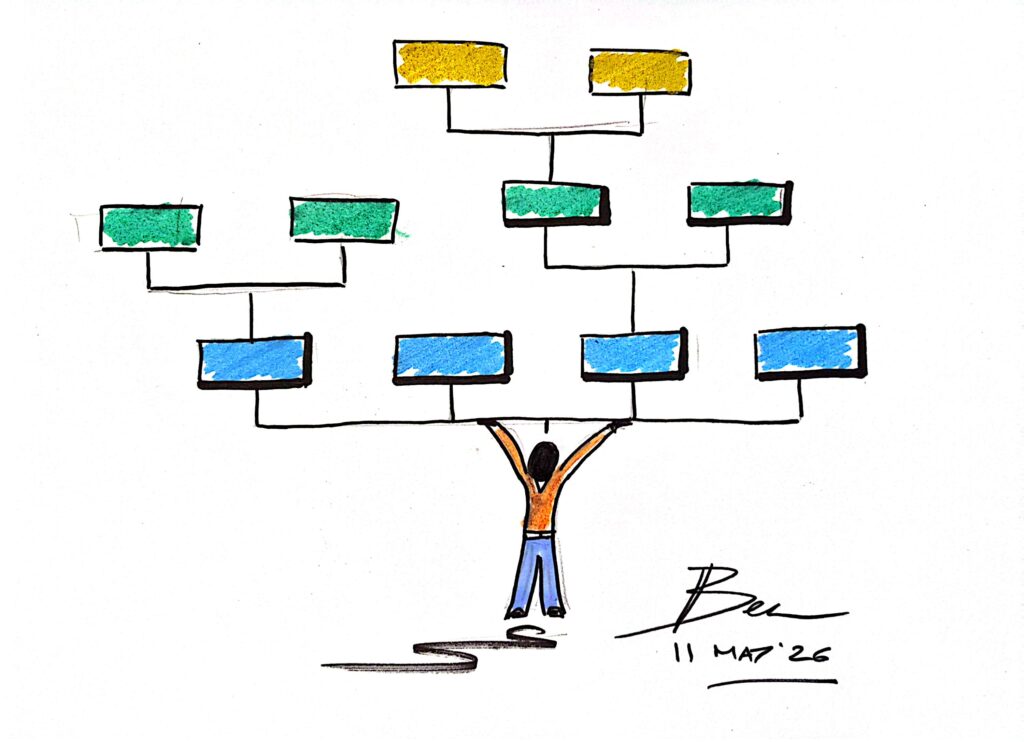
Flip your org charts.
Not metaphorically. Literally.
Turn them upside down so that senior leaders sit at the bottom, supporting the managers above them, who in turn support the teams above them. In other words, make the org chart look less like a hierarchy of control and more like a structure of support.
For senior HR professionals, this might sound almost too simple. But I believe it has real power.
Because the way we draw leadership shapes how people understand it.
And when it comes to leadership development for line managers, that matters enormously.
In many organisations, the traditional org chart quietly reinforces one of the biggest problems in management today: the belief that leadership is about status, authority and being “above” people.
It isn’t.
A leader’s job is to support, develop and look after the people they have the privilege and responsibility to lead, so that those people can deliver the results the leader is ultimately accountable for.
That is not a soft idea. It is a performance idea.
And it should sit at the heart of any serious approach to leadership development for line managers.
The Problem with the Traditional Org Chart
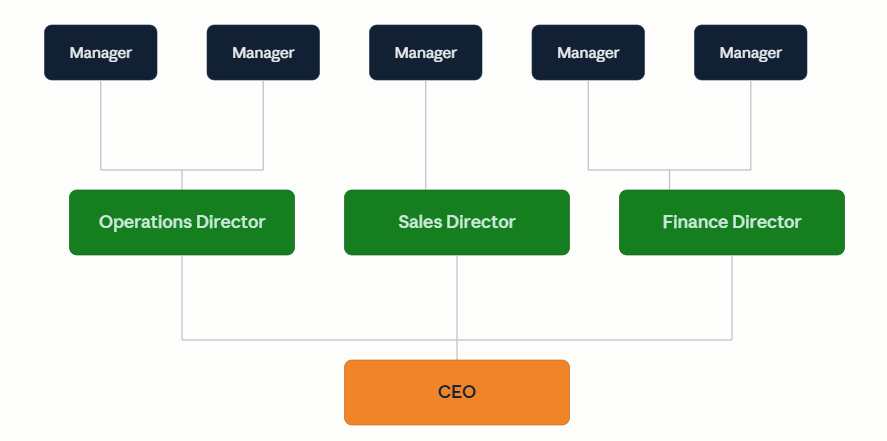
The traditional org chart is usually drawn as a pyramid.
The CEO or senior leader sits at the top. Below them are directors, then heads of department, then managers, then the wider workforce.
It is neat. It is familiar. It helps us understand reporting lines.
But it also sends a message.
Whether we intend it or not, the traditional chart implies that the people at the top are more important than the people below them. It suggests that power, pressure, and decisions flow downwards.
In the worst cases, it encourages leaders to see themselves as sitting above the work, rather than in service of the people doing it.
That is a problem for HR because line manager capability is not just about technical competence. It is about mindset.
You can give managers all the toolkits, frameworks and training in the world, but if they still see leadership as a position of superiority rather than responsibility, very little changes.
That is why leadership development for line managers has to go beyond process, policy and procedure. It has to challenge how managers see themselves and their role.
An upside-down org chart gives you a simple way to do exactly that.
Most HR leaders I speak to are grappling with some version of the same challenge.
They are trying to improve line manager capability, strengthen engagement, reduce burnout, retain talent, improve performance and create healthier cultures.
The common thread running through all of those priorities is the quality of day-to-day management.
A study by Cranfield School of Management found that employees who feel well supported by their line manager are 3.4 times more likely to feel engaged at work.
That means leadership development for line managers is not a side project.
It is one of the biggest levers HR has for improving organisational performance.
But here’s the key point: capability is not just about what managers do. It is also about what they believe their job is.
Do they believe their job is to control, direct and escalate?
Or do they believe their job is to create the conditions in which people can do their best work?
That distinction matters enormously.
Servant Leadership Is Not About Being Soft
The idea of flipping the org chart is closely connected to servant leadership.
The Greenleaf Center for Servant Leadership describes servant leadership as an approach in which the leader focuses on the growth and well-being of people, shares power, puts the needs of others first, and helps people develop and perform as highly as possible.
That is exactly what I mean when I say a leader’s job is to support, develop and look after their people.
It is not about being weak or avoiding difficult conversations.
In fact, I would argue that servant leadership requires more courage than command-and-control leadership.
It requires leaders to ask better questions, give clearer feedback, coach more consistently, set expectations properly and remove barriers that prevent people from succeeding.
It also requires them to accept that their success is achieved through others.
That is a big shift for many managers, especially those who were promoted for their technical excellence as individual contributors.
They often move into management believing they need to have the answers, make the decisions and prove their value by being visibly in control.
Good leadership development for line managers helps them see something different.
It helps them understand that their value as a leader is not measured by how high they sit in the structure. It is measured by how effectively they enable others to succeed.
Flipping the org chart makes that idea visible.
A Visual Cue That Changes the Conversation
One of the reasons I like this idea so much is that it does not require a long explanation.
When people see an upside-down org chart, they notice it.
They pause.
They ask the obvious question:
“Why is the org chart upside down?”
That question creates the perfect coaching moment.
My favourite response, which has to be delivered with the right tone and a slight smile, is:
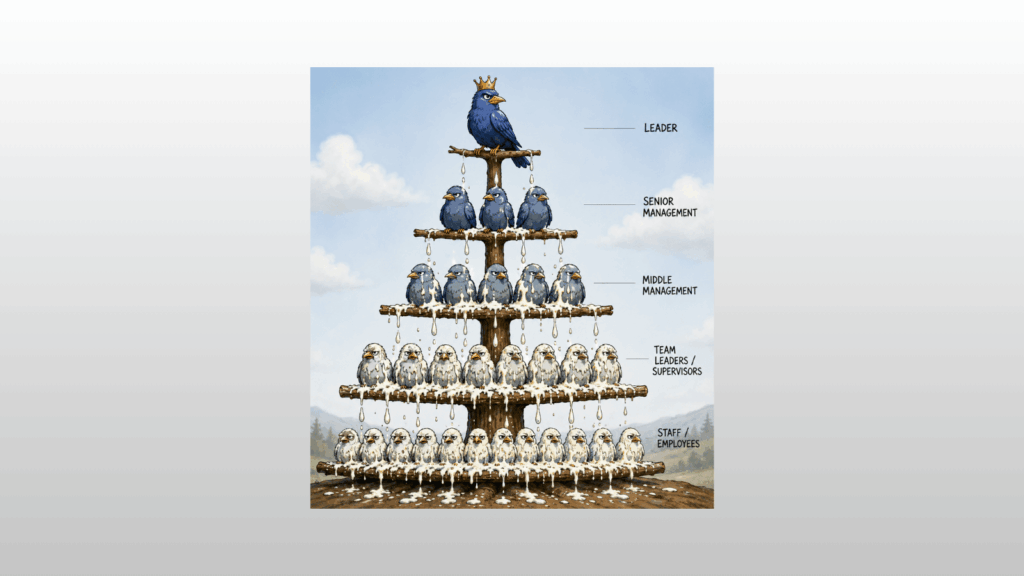
“Because our job as leaders is to support and enable the people we lead to do their job, not dump on them from above.”
That line usually gets a laugh.
But it also lands.
Because everyone knows what it feels like when leadership becomes a cascade of pressure rather than a system of support.
Senior leaders pass the pressure to middle managers. Middle managers pass pressure to team leaders. Team leaders pass pressure to frontline employees. And before long, the whole organisation is operating in survival mode.
The upside-down org chart interrupts that pattern.
It reminds leaders that pressure should not simply be pushed downwards. Support should flow upwards.
And that is a powerful idea to build into leadership development for line managers.
I know some people will dismiss this as a symbolic gesture.
But symbols matter in organisations.
Office layouts, meeting rituals, job titles, performance dashboards, leadership behaviours and internal language all tell people what is really valued.
The org chart is one of those symbols.
When it is drawn in the traditional way, it reinforces hierarchy.
When it is flipped, it reinforces service.
The people closest to customers, clients, patients, residents or service users are often the people creating the most immediate value. The leader’s role is to ensure they have the clarity, confidence, capability, and resources to do that work well.
For HR, this is a practical way of reinforcing a leadership philosophy that can otherwise remain abstract.
You can talk about empowerment, engagement and psychological safety all day long.
But sometimes a simple visual shift does more than another slide deck ever could.
What an ‘Upside-Down’ Org Chart Communicates
When you flip the org chart, you communicate several important messages.
First, you communicate that leadership is a responsibility, not a reward.
Too many organisations still treat management as the natural next step for high performers. Someone is good at the job, so they are promoted to manage people who do the job.
But management is not just a promotion. It is a change of profession.
The work becomes less about personal delivery and more about enabling others to deliver.
That is why leadership development for line managers is so important. New and existing managers need to understand that leadership requires a different set of behaviours, habits and responsibilities.
Second, you communicate that employees are not there to serve the manager’s ego or convenience.
They are there to do meaningful work, deliver outcomes and contribute to the organisation’s purpose. The manager’s job is to help them do that.
Third, you communicate that support is not optional.
It is part of the role.
That includes coaching, feedback, clarity, challenge, wellbeing, recognition and development.
Finally, you communicate that accountability still matters.
This is important. Flipping the org chart does not remove accountability from leaders. If anything, it sharpens it.
The leader remains accountable for results. But they achieve those results by building an environment in which people can perform.
Three Questions Every Line Manager Should Be Able to Answer
If you want to make this idea practical, here are three questions I would encourage every line manager to reflect on.
These questions can also be built directly into your leadership development for line managers, whether through workshops, manager induction, coaching sessions, or performance conversations.
#1. What do my people need from me to do their best work?
This sounds simple, but many managers never properly ask it.
The answer might be clearer priorities, faster decisions, better equipment, more autonomy, more feedback, fewer meetings or protection from organisational noise.
The point is that support must be specific.
Generic support rarely changes anything.
#2. How am I developing the people I lead?
Development is not something that only happens on training courses.
It happens through stretch assignments, coaching conversations, delegation, feedback, reflection and exposure to new challenges.
If a manager is not developing their people, they are not doing their job fully.
#3. How am I looking after the human being, not just managing the employee’s work?
This is where many organisations still fall short.
People are not resources in the mechanical sense. They have energy levels, confidence, personal circumstances, aspirations, fears and values.
Good leaders pay attention to all of that.
They do not become counsellors or therapists, but they do create the conditions where people feel seen, supported and able to speak up before small issues become big ones.
What This Means for Senior Leaders in Your Organisation
The biggest test of this idea is not whether frontline managers like it.
The biggest test is whether senior leaders are willing to live it.
Because if the executive team still behaves as though hierarchy equals importance, the upside-down org chart becomes decoration.
Senior leaders need to ask themselves:
“Are we genuinely supporting the leaders below us?”
“Are we giving managers the time, training and clarity they need?”
“Are we modelling the behaviours we expect from them?”
“Are we removing organisational barriers, or simply adding more pressure?”
This matters because managers are often squeezed from both directions. They are expected to deliver strategic priorities from above while supporting the well-being, engagement and performance of their teams.
If senior leaders do not support managers properly, managers will struggle to support their people properly.
The support system has to run throughout the organisation.
That means leadership development for line managers cannot sit in isolation. It has to be supported by senior leadership behaviour, performance expectations, promotion criteria, and the organisation’s wider culture.
A Simple Exercise for Your Next Leadership Development Session
Here is a practical exercise you can use.
Take a traditional org chart for one function, department or leadership team.
Print it out.
Then turn it upside down.
Ask the group:
“What does this version of the chart ask of us that the traditional version does not?”
Then ask each leader to write down three specific commitments:
- One thing I will do to support my people more effectively.
- One thing I will do to develop my people more intentionally.
- One thing I will do to better look after the people I lead.
Keep it simple.
The power is not in the complexity of the exercise. The power is in the shift of perspective.
And for HR teams looking for simple, practical ways to strengthen leadership development for line managers, that shift of perspective can be incredibly valuable.
A Final Thought
Improving line manager capability does not always require a new competency framework, a new platform or a six-month programme.
Sometimes it starts with changing the picture.
Flip the org chart.
Use it to start a different conversation about leadership.
Because when we show leadership as support rather than status, we remind managers of the real job.
To support.
To develop.
To look after.
To enable performance through people.
And if you need further support, learn more about how I can help you here.
Your coach,
Two things you can do to say thank you for this free resource
Subscribe to ”The Ben Morton Leadership Podcast“ on your preferred podcast platform to help us grow the show and bring you more fantastic interviews with senior leader
Connect with me on LinkedIn for regular leadership tips and insights. Be sure to add a personal note with the request.
Connect with Ben