Published on 10th March 2025
Table of Contents
- What is the Decision Tree?
- How Does the Decision Tree Work?
- The Four Levels of the Decision Tree
- A Practical Example of Using the Decision Tree
- The Real Value of the Decision Tree
What is the Decision Tree in Business?
I first came across the Decision Tree model in Susan Scott’s Fierce Conversations, and it immediately struck me as a brilliantly simple way to delegate decision-making. I’ve since used it with leaders I coach and groups I train to help them think critically about who should make which decisions and at what level.
A decision tree, in the context of leadership, is a visual or conceptual tool that helps leaders make structured, logical decisions by mapping out possible choices, their outcomes, and potential consequences. It’s essentially a simple framework for delegating authority within a team.
How does a Decision Tree work?
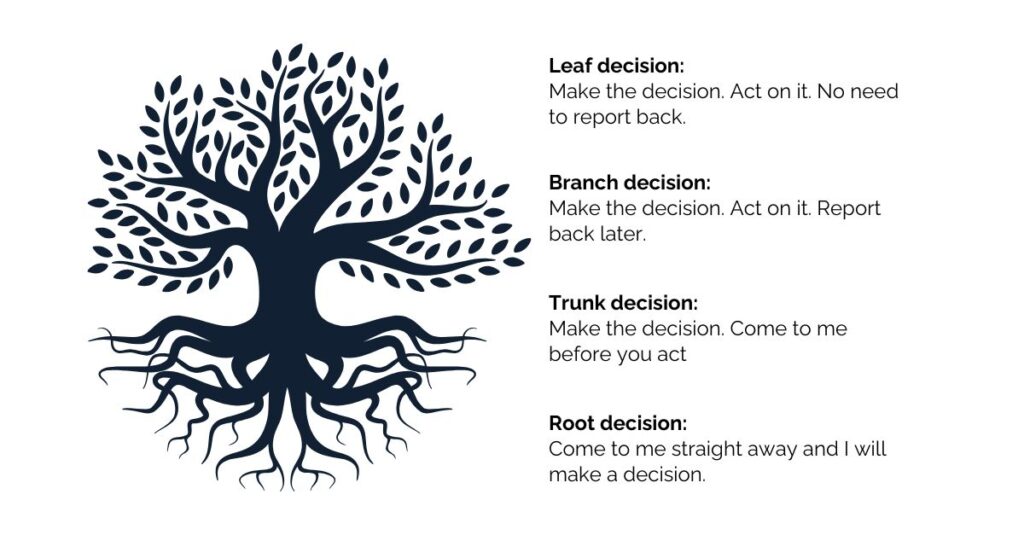
The decision tree is a visual metaphor to help leaders and their direct reports understand the level of decision making authority they have in different situations. It involves four levels of authority or freedom. each representing different degrees of impact and responsibility.
- Leaf decisions are everyday, low-risk choices that team members can make independently, much like plucking a leaf from a tree if one goes wrong, the consequences are minimal.
- Branch decisions carry more weight; they require managers to take ownership and act, but they should inform leadership afterward, similar to a branch that can regrow if damaged.
- Trunk decisions are foundational and have the potential to significantly affect the business. Team members should develop solutions, consult with leadership, and gain approval before acting, because poor choices here can have lasting consequences, like damaging a tree’s trunk.
- Finally, root decisions determine the future health and direction of the organization. These critical choices are made by the most senior leaders, with input from others valued but ultimate responsibility resting at the top, just as the roots sustain and anchor the entire tree.
Not all decisions carry the same weight. Some are low-risk and can be made independently, while others require consultation or final approval. By categorising decisions into four levels, leaders can empower their teams while keeping control of the most critical choices.
The Four Levels of the Decision Tree
Leaf Decisions
Leaf decisions are the everyday, low-risk choices that occur within teams and departments. These decisions are quick, simple, and typically don’t require consultation with leadership. Much like plucking a leaf from a tree, making a wrong choice at this level has minimal impact and rarely disrupts operations.
Encouraging team members to handle leaf decisions independently builds confidence, fosters autonomy, and frees leaders to focus on higher-priority issues. Clear guidelines and trust in your team ensure that these small decisions contribute positively to overall productivity without constant oversight.
Branch Decisions
Branch decisions carry slightly more weight and responsibility. While not critical to the organisation’s core, poor choices at this level can cause delays or require corrective actions, much like a damaged branch that eventually regrows but takes time.
Leaders should empower managers to make these decisions, take ownership, and act decisively, but they should also be informed afterward. A practical approach is to adopt the “make the call, act, and report” guideline. This ensures accountability while allowing for agility in daily operations.
Branch decisions are an opportunity for emerging leaders to demonstrate judgment and problem-solving skills.
Trunk Decisions
These are foundational decisions that could significantly impact the business. Like damaging the trunk of a tree, a poor decision at this level can have long-lasting consequences.
Team members tasked with trunk decisions should develop solutions thoughtfully, consult leadership for guidance, and gain approval before implementing any action. These decisions often involve strategic planning, resource allocation, or operational changes that affect multiple teams. Leaders must strike a balance between empowering others to propose solutions and ensuring that the final choice aligns with organisational goals.
Root Decisions
Root decisions are the most critical, shaping the very future and health of the organisation. These decisions should be grounded inthe company’s core values, as they often affect the long-term strategy, or sustainability, much like how roots sustain and anchor a tree. They must be made by the most senior leaders, such as executives, business owners, or board members, while still valuing input from others.
Leaders often frame these decisions as collaborative discussions but retain ultimate accountability. Because of their long-term implications, root decisions require careful deliberation, foresight, and alignment with the business’s mission and vision to ensure the continued growth and stability of the entire enterprise.
A Practical Example of Using the Decision Tree
Imagine a team leader at a marketing agency overseeing a campaign launch.
Leaf Decisions
A junior team member notices a minor typo in a social media post. Because this is a low-risk, everyday decision, they correct it immediately without consulting the leader. The team benefits from quick action, and the leader doesn’t need to get involved.
Branch Decisions
A project manager needs to reallocate some design resources to meet a client’s tight deadline. This decision is slightly more impactful. It affects workload and scheduling, but it can be made independently, provided the leader is informed afterward. The project manager adjusts assignments, informs the team, and updates the leader on the change.
Trunk Decisions
The team discovers that a key campaign concept isn’t working during testing. Changing the concept could significantly affect the campaign’s success. Here, the marketing lead collaborates with the leader to evaluate alternatives, present a solution, and get approval before implementing changes. This ensures alignment with strategic goals and prevents costly mistakes.
Root Decisions
The agency is considering entering a new market segment, which could affect the company’s long-term strategy and financial health. This decision rests with senior executives or the business owner. While input is gathered from marketing, finance, and operations teams, the ultimate decision is made at the top to ensure it aligns with the company’s mission and growth plans.
This decision tree example shows how decisions of varying impact can be appropriately delegated, allowing leaders to focus on high-level strategy while empowering the team to act independently when safe.
The Real Value of the Decision Tree
The power of the Decision Tree isn’t in producing a static document listing every possible decision and categorising them.
While mapping out a few key decisions with your team can be a useful exercise to introduce the concept, this is not its true value. This isn’t another form of RACI.
The real value comes from having a common language—a decision-making shortcut that makes delegation clearer and faster. It’s like when you go to the doctor with an illness: as soon as they diagnose it and give it a name, managing it becomes much easier.
Imagine a team conversation where someone asks, “Is this a branch decision or a trunk decision?”—in just a few words, everyone instantly understands the level of authority required, cutting through uncertainty and speeding up decision-making.
When leaders and teams use this language daily, decision-making becomes smoother, faster, and less stressful—freeing up senior leaders while empowering managers to take ownership with confidence.
Want more real-time leadership support?
Ben AI, my virtual leadership coach, provides instant, practical guidance to help you navigate leadership challenges.
Your coach,

Found this useful? Each week, I send out The Leader’s Kit Bag – a short, practical email with one idea and one tool to help you take one step forward as a leader.
You can get the next one here.
Your coach,
Two things you can do to say thank you for this free resource
Subscribe to ”The Ben Morton Leadership Podcast“ on your preferred podcast platform to help us grow the show and bring you more fantastic interviews with senior leader
Connect with me on LinkedIn for regular leadership tips and insights. Be sure to add a personal note with the request.
Connect with Ben